

A Paper Story Alternative for Wedding Stationery
Last Updated: November 14, 2026
Quick Summary
A paper story alternative for wedding stationery means choosing handmade paper, such as Lokta or cotton rag, over standard machine-printed card so your invitations feel personal and tactile. Handmade paper starts from £0.30 per sheet, costs more per unit than standard card, and needs a physical proof before you commit to a full run.
- Handmade paper starts from £0.30 per sheet and costs more per unit than standard card.
- Choose Lokta for texture and a tree-free story, cotton rag for a smoother, heavier finish.
- Order invitations eight to twelve weeks before the wedding so replies arrive in time.
- Approve a physical proof on the actual stock, because colour and type size shift on textured paper.
- Build your budget from paper, printing, design fees, proofing and postage, not the sheet alone.
Table of Contents
- Why Couples Seek a Paper Story Alternative for Wedding Stationery
- Comparing Costs: Handmade Paper vs Standard Wedding Stationery
- Alternative Wedding Invitations That Still Feel Formal
- Wedding Invitation Paper Types: Lokta, Cotton Rag and Textured Stock
- Eco-Friendly Wedding Stationery Beyond the Paper Itself
- Wedding Stationery Printing on Handmade Paper: Proofing and Turnaround
- Choosing Your Invitation Suite from The Natural Paper Company
- Frequently Asked Questions
Why Couples Seek a Paper Story Alternative for Wedding Stationery
A paper story alternative for wedding stationery usually comes down to one thing: couples want invitations that feel like theirs, not like a template with a name dropped in. If you have been comparing printed suites online and everything starts to blur, you are not alone. At The Natural Paper Company, we hear the same request again and again: something tactile, something considered, and something that does not cost the earth in either sense of the phrase.
The shift is real. Many couples now plan a wedding with sustainability in mind, and stationery is one of the first places that intention shows up. Paper is physical, it gets posted, and guests keep it. That makes the material choice matter more than most people expect.
Below, we break down the honest trade-offs: cost, paper types, printing, proofing, and how to build a suite that holds together from save-the-dates to place cards.
Comparing Costs: Handmade Paper vs Standard Wedding Stationery
Standard wedding stationery is usually cheaper per unit, but the gap is smaller than most couples assume once you factor in what you actually get. Machine-printed card from a high-street printer is quick and predictable. Handmade paper costs more per sheet because someone made it by hand, and that is the whole point.
Here is how the two approaches compare on the things that decide a budget:
| Factor | Standard Stationery | Handmade Paper Stationery |
|---|---|---|
| Cost per invitation | Lowest upfront | Higher per unit, from £0.30 per sheet |
| Texture and finish | Uniform, smooth | Textured, individual, tactile |
| Printing method | Digital or offset | Digital on textured stock, or hand calligraphy |
| Minimum order | Often fixed packs | Flexible, single sheets or packs of ten |
| Reordering later | Easy, identical | Possible, with natural variation |
| End-of-life | Often mixed coatings | Recyclable, compostable paper |
The honest caveat: handmade paper is not the cheap option. If your guest list runs to 150 households and the budget is tight, standard card plus a beautiful envelope may serve you better. If you are inviting 40 people and want the invitation to be a keepsake, the cost per guest is modest and the difference is obvious in the hand.
If you want to see the real numbers side by side, our Misty Rose handmade cotton rag paper card and envelopes are a good place to start.
Alternative Wedding Invitations That Still Feel Formal
Alternative wedding invitations do not have to mean casual. The formal feel comes from typography, layout and restraint, not from a stiff white card. Swap the card stock and keep the discipline, and the result reads as elegant rather than informal.
Three formats work particularly well for a formal celebration:
- Botanical Lokta cards with a simple serif typeface and generous margins
- Cotton rag card sets in soft neutral tones with letterpress-style printing
- Folded cards with a printed order of service tucked inside for the ceremony
What most guides miss is that texture does the formal work for you. A smooth card needs foil and embossing to feel expensive. A textured sheet already looks considered, so you can keep the design quiet.
Watch out: heavily patterned paper plus ornate script plus a wax seal plus ribbon is too much. Pick one feature to lead and let the rest stay plain.
If you want a ready-made route, our Vanilla handmade cotton rag envelope and card set is formal enough for a church or registry ceremony without any design work on your part.
Wedding Invitation Paper Types: Lokta, Cotton Rag and Textured Stock
Wedding invitation paper types fall into three practical groups: Lokta, cotton rag, and textured machine-made stock. Each behaves differently under a pen, a printer and a postal sorting machine, so the choice should follow how you plan to fill the card and how it will be handled.
Lokta paper is handmade in Nepal from the inner bark of high-altitude daphne shrubs. No trees are cut down to produce it, the shrubs regrow after harvesting, and the paper is acid-free and remarkably tear-resistant. It has a visible, slightly irregular texture and soft natural tones. Real petals and leaves are often embedded during making, which is why no two sheets match. Lokta is a light, absorbent, uncoated paper, so ink and pen behaviour depends heavily on the nib and the ink you choose. Test a sheet before committing to a full run.
Cotton rag paper is a smoother, heavier option with a soft, dense feel. Its weight means postage should be checked before you commit to a full suite.
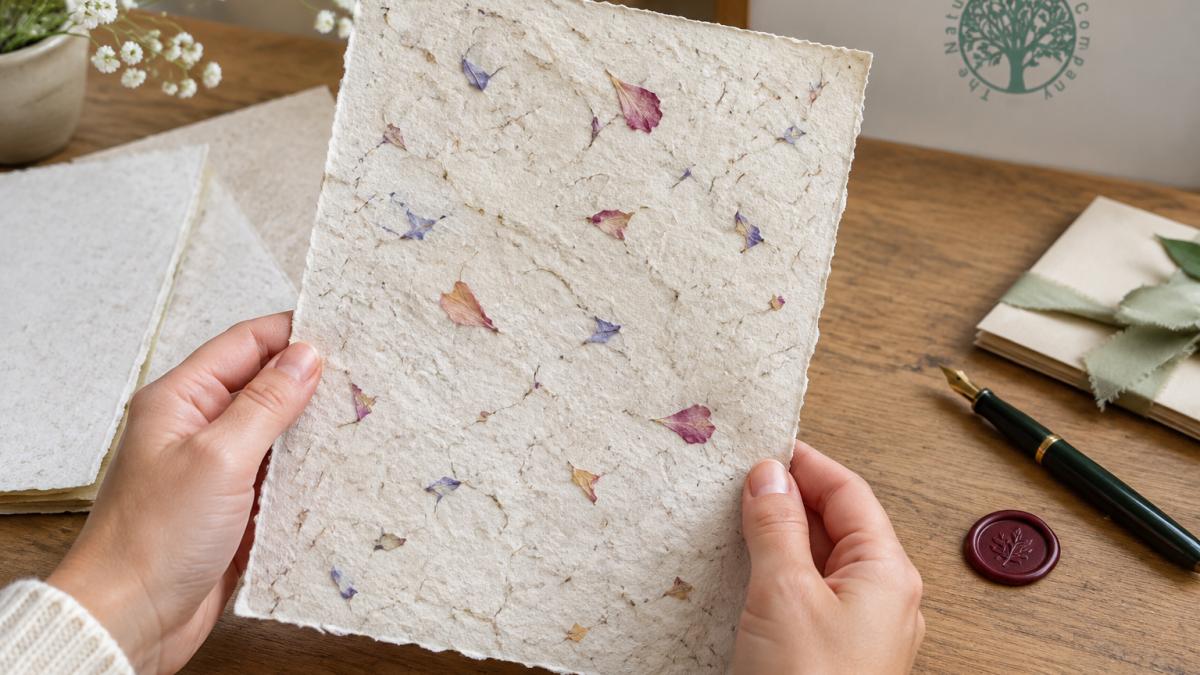
Fountain pen performance varies with the paper and the ink, so test one sheet before committing to a larger order, and test the envelope as well.
A simple decision rule: choose Lokta when texture and a tree-free story matter most, and choose cotton rag when you need a smoother, heavier finish. Our Marigold Lokta paper and envelopes show the embedded-petal finish.
Eco-Friendly Wedding Stationery Beyond the Paper Itself
Eco-friendly wedding stationery is about more than the sheet. The ink, the envelope, the seal and the delivery all count, and this is where most green claims fall apart under scrutiny.
Start with what you can verify:
- Tree-free paper. Lokta is made from the inner bark of shrubs, and no trees are cut down to produce it.
- Ungummed envelopes. The envelopes are supplied ungummed, which suits finishing with a wax seal.
- Digital where it fits. A wedding website for the details, a paper invitation for the moment.
For a vegan option that keeps the eco story consistent, our Natural handmade vegan card avoids animal-derived materials entirely.
Wedding Stationery Printing on Handmade Paper: Proofing and Turnaround
Printing on handmade paper works well, but it needs a proof. Textured sheets pull ink differently from smooth card, and a design that looks crisp on screen can soften or spread on a fibrous surface.
A typical proofing approach, in the order we suggest:
- Order a small paper sample first. Print your design on one sheet before committing to the full run.
- Approve a physical proof. Check colour, type size and margins on the actual stock, not a PDF.
- Confirm your quantities and deadline. Allow time for proofing, printing and posting, and add a buffer for reprints.
- Print a spare set. Handmade paper varies sheet to sheet, so keep extras for late guests and replacements.
If you want to test printing before you commit, the Natural handmade paper is available on its own.
Choosing Your Invitation Suite from The Natural Paper Company
An invitation suite is the full set: save-the-dates, the invitation, RSVP cards, guest information, menus, place cards and a table plan. The trick is to choose one paper family and one typeface, then let the formats vary. But the more useful question for anyone searching for a Paper Story alternative is not what a suite contains, it is how the available routes compare once cost, turnaround and personalisation limits are on the table. Most guides skip that comparison. Here it is.
Transparent costs to budget for. Handmade paper starts from £0.30 per sheet, but the sheet is only one line. Build your budget from: paper and envelopes per invitation; printing or calligraphy per piece; a design fee if you commission; proofing and sample costs; and postage, which rises sharply once a suite passes 100 g. A common pattern is that the paper is the smallest part of a bespoke quote and the design and print time are the largest. Ask for a written breakdown before you approve anything.
Turnaround and proofing. Order your save-the-dates as soon as your date and venue are confirmed, and your invitations eight to twelve weeks before the wedding so replies arrive in time for the caterer. Watch out: a proof approved on screen is not a proof, colour and type size shift on textured stock, so approve a physical sample on the actual paper.
Environmental impact beyond the paper. Compare packaging, print method, shipping and disposal, not just the sheet. Uncoated, unbleached stock recycles easily; foil, laminate and plastic ribbon do not. Ask what is printed on the paper before you accept a recyclable claim, and choose a printer who will ship without plastic wrap if that matters to you.
Our suggestion for many couples: pick a Lokta botanical paper for the invitation and envelopes, keep the typography classic, and finish with a wax seal. If you are still weighing routes, start with a small paper sample and a physical proof before you commit to the full run.
The hardest part is not choosing a paper. It is holding the whole suite together across save-the-dates, invitations, menus and place cards without it drifting. The Natural Paper Company makes that simpler with handmade Lokta and cotton rag papers, a personalised printing service for textured stock, and wax seals and silk ribbons to finish the set. Start with a sample sheet, approve a proof, and build the suite from there.
Frequently Asked Questions
What paper is best for wedding invitations?
The best paper depends on the finish you want and how the invitations will be printed. Handmade Lokta paper suits couples who want visible texture and botanical detail. Cotton rag gives a smoother, heavier feel. Order a sample first and test your chosen printing method on it before committing to a full run.
Can wedding invitations be printed on handmade paper?
Yes. Handmade Lokta paper from The Natural Paper Company is described as easy to print on, which makes handmade invitations achievable without a specialist press. Textured surfaces absorb ink differently from smooth stock, so test a sample sheet before the full order.
Where can I find eco-friendly wedding stationery?
Look for papers made from renewable fibres rather than cut trees. Lokta paper is made from the inner bark of high-altitude daphne shrubs, and harvesting supports regrowth without lasting harm to forests. Pair it with ungummed envelopes, which suit finishing with a wax seal. The Natural Paper Company's Lokta range starts at £0.30 per sheet or envelope, giving you a transparent starting cost for an eco-friendly suite.
How can I make wedding stationery feel more personal?
Start with paper that already carries character, such as Lokta sheets with real embedded petals, where no two pieces look alike. Add handwritten names, a wax seal in your colour palette, and ribbon to finish. Keep the wording true to you.
Are digital wedding invitations a good alternative to printed invitations?
Digital invitations suit couples with tight budgets, short timelines or guests spread across countries, and they make RSVP tracking simple. They lack the tactile quality of paper, though, and some guests expect something physical for a formal celebration. A common compromise is a digital save-the-date followed by a printed invitation suite on handmade paper for the main event. That keeps costs down on the early notice while giving the wedding itself a keepsake-quality invitation.
