

How to Buy Recycled Paper Gift Wrap in Bulk
Last Updated: October 28, 2026
Quick Summary
The easiest way to buy recycled paper gift wrap bulk in the UK is to estimate how many parcels you will wrap over 12 months, pick a plain post-consumer recycled paper, then compare cost per sheet across suppliers. Include delivery, VAT and wastage in the calculation.
- Count your gifts over 12 months and round up to allow for mistakes.
- Choose post-consumer waste paper and check the stated recycled content percentage.
- Choose plain, uncoated designs, since metallic foil and glitter may not be kerbside recyclable.
- Compare suppliers on cost per sheet, including delivery, VAT and unusable offcuts.
- Store rolls and sheets flat in a cool, dry place away from direct sunlight.
Table of Contents
- Why Recycled Paper Gift Wrap Is Worth Buying in Bulk
- Step 1: Decide How Much Paper You Actually Need
- Step 2: Choose the Right Type of Recycled Paper
- Step 3: Check the Recyclability and Sustainability Claims
- Step 4: Compare Bulk Prices and Suppliers in GBP
- Step 5: Add Personalised Printing Without Losing Quality
- Booking Your Bulk Order and Storing It Properly
- Frequently Asked Questions
Why Recycled Paper Gift Wrap Is Worth Buying in Bulk
Buying wrapping paper in bulk can be useful for people who wrap gifts often. Compare the handmade lokta gift bags as a sturdier alternative to plain wrap.
Bulk buying can suit people who wrap gifts often, including small shop owners, event planners, wedding couples, and families who celebrate several occasions a year.
Most of the value comes from knowing what you need before you order. The sections below walk through the process step by step, from working out your quantity to storing the paper once it arrives.
Step 1: Decide How Much Paper You Actually Need
Start by counting your gifts over the next 12 months. Note the typical size of each parcel, since a large box can use a full sheet while a card needs only a small offcut. Add a margin for mistakes, which every wrapper makes.
A simple way to estimate is to measure the largest parcel you usually wrap and multiply its dimensions by the number of parcels. Round up. It is far more frustrating to run out in December than to have a spare roll in March.
Keep in mind that Lokta sheets measure approximately 50cm × 76cm each.
Step 2: Choose the Right Type of Recycled Paper
Recycled gift wrap is not one product. Paper grades differ in texture, strength and how well they take printing, so choose the type that suits your use before you think about price.
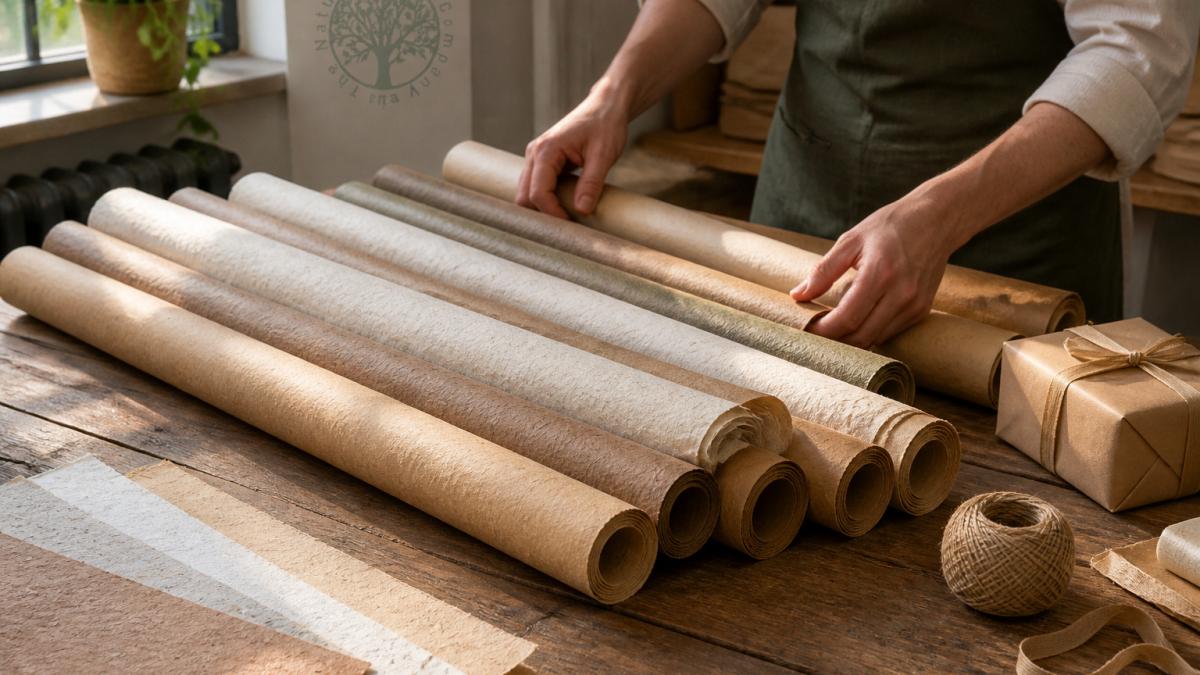
Post-consumer waste versus other recycled grades
Post-consumer waste paper is made from paper that has already been used and collected for recycling. Look for the proportion of recycled content on the label. A higher share generally means less virgin fibre, though finish and weight vary between suppliers. Ask a supplier for the exact recycled content if it is not stated.
Lokta and cotton rag alternatives
Lokta paper is handmade in Nepal from the inner bark of the Daphne shrub, which regenerates after harvest. For a detailed guide to picking cotton rag paper, see how to choose it for art and print. Read a side-by-side look at recycled paper versus bamboo paper to see how the materials differ. Our Niwa Lokta Wrapping Paper (£2.99) has a blue and white botanical design and is described for birthdays, weddings and Christmas. Our Golden Vine (£2.99) and Harvest (£2.99) designs use a metallic gold finish, while Fiore (£2.99) is another gold botanical option.
Step 3: Check the Recyclability and Sustainability Claims
Sustainability claims on gift wrap are easy to make and hard to verify. This section goes beyond the label: what recycled content actually means, how finishes affect whether paper can be recycled at all, and how recycled and virgin paper compare across their lifecycles.
Read the claim, then ask for the evidence
- Recycled content percentage, stated as post-consumer waste (paper already used and collected) or pre-consumer waste (mill offcuts). Post-consumer content is generally the stronger environmental claim.
- Plastic-free construction, no polythene coating or lamination.
- Ink type, water-based or vegetable-based inks are preferable to solvent-based.
- Certification, ask for the certificate, not just the logo, and check what it actually covers.
How finishes affect recyclability
This is the detail most guides skip. Standard kerbside paper collections in the UK accept plain paper, but the following can cause a sheet to be rejected or contaminate a load:
- Metallic foil and glitter, the plastic or metal layer does not break down in the paper recycling process.
- Heavy lamination or plastic coating, makes the sheet a composite material, not paper.
- Sticky tape and ribbon left on, should be removed before recycling.
If a design uses a metallic finish, check with your local council whether it is accepted. Where it is not, the sheet may need to go to a specialist handler or, failing that, general waste. Choosing a plain, uncoated design is the simplest way to guarantee kerbside recyclability.
Recycled versus virgin paper: the lifecycle comparison
Most sites assert that recycled is better without showing why. The mechanism is straightforward:
- Fibre source, recycled paper displaces virgin wood pulp, reducing demand for freshly harvested fibre.
- Energy and water, reprocessing recovered fibre generally uses less energy and water than pulping virgin timber, though the gap depends on the mill and the grade.
- Landfill avoidance, every tonne of paper recovered and reprocessed is a tonne diverted from landfill, where it would generate methane as it decomposes.
- Transport, locally made or locally converted paper carries a lower transport burden than imported stock, which matters for a UK buyer comparing a domestic supplier with an overseas one.
The honest caveat: recycled paper is not automatically low-impact. De-inking, additional processing and long-distance transport all carry a cost. The strongest choice combines high post-consumer content, plastic-free construction and a short supply chain.
Apply the waste hierarchy
The most sustainable sheet is the one you use fully. Before recycling, consider:
- Reuse, save large offcuts and intact sheets for smaller gifts next season.
- Recycle, plain paper in kerbside collections, finishes removed.
- Dispose, only as a last resort for composite or heavily finished paper.
A note on "plastic-free" and vegan claims
Plastic-free usually refers to the paper and any coating, not necessarily the tape, ribbon or packaging it arrives in. Vegan claims concern animal-derived ingredients in inks or finishes. Ask what each claim covers so you are comparing like with like.
Step 4: Compare Bulk Prices and Suppliers in GBP
Headline prices are the least reliable way to compare bulk gift wrap. A roll priced at £4.99 can be worse value than a pack at £12.00 once you account for sheet size, delivery and the amount you actually use. Work everything back to a single unit, cost per square metre, or cost per sheet if you wrap by the sheet, and compare on that basis. Calculating these dimensions accurately prevents unnecessary waste, ensuring that your materials are used efficiently according to the techniques in this gift wrapping guide.
Build a true cost per sheet
Use this formula for every supplier you shortlist:
Cost per sheet = (pack price + delivery + VAT if applicable) ÷ number of usable sheets
Two adjustments matter in practice. First, subtract wastage: if a pack includes offcuts too small for your typical gift, those sheets are not really usable. Second, check whether the quoted price includes VAT, most consumer-facing prices do, but trade and wholesale quotes often exclude it, which can make a supplier look 20% cheaper than it is.
What bulk pricing actually looks like
Ask each supplier for their tier breakpoints in writing. A supplier who will not publish or confirm them is harder to budget against.
Delivery, minimums and lead times
- Free delivery thresholds, many suppliers set one, and it is often worth topping up an order to reach it.
- Minimum order values, trade accounts frequently require a minimum spend before tier pricing applies.
- Lead times, standard stock may ship in days, while custom-printed or handmade paper can take several weeks. Build this into your seasonal planning.
Compare at least three suppliers
Keep a simple comparison sheet with columns for cost per sheet, delivery charge, VAT status, minimum order and lead time. Prices change seasonally, so confirm current figures on each supplier's website before you commit, and ask whether they honour a quoted price for a stated period.
The total cost of ownership angle
Most buying guides stop at the price tag. The fuller calculation includes what you save by buying once: fewer repeat delivery charges, less packaging waste from multiple small orders, and less time spent reordering mid-season. A slightly higher upfront bulk price can still be the cheaper option across a year, which is the real comparison to make.
The table below sets out the cost-per-sheet formula and the checks to run on each supplier before you commit.
| Factor | What to check | Why it matters |
|---|---|---|
| Pack price | Quoted price per pack | Starting point for the calculation |
| Delivery | Charge and free-delivery threshold | Can make a cheap pack costly |
| VAT | Whether the quote includes VAT | Trade quotes often exclude it |
| Usable sheets | Subtract offcuts too small to use | Sets the real sheet count |
| Minimum order | Spend needed for tier pricing | Affects bulk eligibility |
| Lead time | Days for stock, weeks for custom | Shapes seasonal planning |
Step 5: Add Personalised Printing Without Losing Quality
The Natural Paper Company offers a personalised printing service for handmade paper.
Booking Your Bulk Order and Storing It Properly
Store rolls and sheets flat or rolled in a cool, dry place, away from direct sunlight. Humidity can cause paper to warp or the surface to mark, so avoid damp cupboards and garages. Keep metallic designs away from moisture, as this can dull the finish over time.
Browse our handmade wrapping papers to find a design for your next order.
Frequently Asked Questions
Where can I buy recycled wrapping paper in the UK?
The Natural Paper Company offers handmade Lokta wrapping papers at £2.99 per sheet. The listed designs include Niwa, Golden Vine, Harvest and Fiore.
Is recycled wrapping paper recyclable after use?
Most uncoated recycled paper can go in household paper recycling, but foil, glitter, heavy metallic coatings and plastic-laminated finishes often cannot. Tear off any sticky tape and ribbon before recycling. Handmade papers such as Lokta are generally best kept for reuse in crafts, cards or bookbinding, as their natural fibres suit creative reuse well.
How much wrapping paper do I need for a batch of gifts?
A single Lokta sheet measures approximately 50cm × 76cm.
Can I order personalised recycled wrapping paper in bulk?
The Natural Paper Company offers a personalised printing service for handmade paper.
