

How to Decide if Artisanal Stationery Is Worth It
Last Updated: October 27, 2026
Quick Summary
Artisanal stationery is worth it when the paper's job justifies the cost per finished piece, not the cost per sheet. A £2.25 sheet is modest across 80 wedding invitations but a real premium for one birthday card, so match the paper to its use.
- Paper weight is measured in gsm, with 150 gsm for letter writing and 300 gsm card for invitation bases.
- Order a single sample sheet before any bulk order to catch texture or weight mismatches.
- Add 10 per cent for spoilage on printed runs, or 20 per cent for first-time home printing.
- Test each sheet for bleed-through, feathering, drying time, opacity and texture grip before committing.
- Lokta paper comes from the inner bark of daphne shrubs, and no trees are cut to produce it.
Table of Contents
- What Makes Artisanal Stationery Different
- Handmade Stationery vs Mass-Produced: The Real Differences
- The Cost Per Sheet: What You Actually Pay For
- How Artisanal Papers Perform With Ink and Printers
- Handmade Paper Wedding Invitations: Where the Value Shows
- Sustainable Wedding Invitations and Sourcing Claims
- DIY Wedding Invitation Printing on Textured Paper
- Who Gets the Most From Artisanal Stationery
- Frequently Asked Questions
What Makes Artisanal Stationery Different
Artisanal stationery is paper made by hand, sheet by sheet, rather than cut from a machine-fed roll. At The Natural Paper Company, each sheet is made individually by hand using traditional techniques.
Paper Weight, Texture and Finish Explained
Paper weight is measured in gsm, or grams per square metre.
- 150 gsm paper suits letter writing, calligraphy, and layered invitations
- 300 gsm card holds its shape for invitation bases and covers
- Medium-rough texture grips ink and pencil without skipping
- Deckled edge is the torn, uneven border left by hand-forming
Handmade Stationery vs Mass-Produced: The Real Differences
Cotton rag paper is acid-free, and Lokta paper comes from the inner bark of high-altitude daphne shrubs. No trees are cut to produce Lokta paper.
The Cost Per Sheet: What You Actually Pay For
Here are some product prices:
| Product | Price | Best For | Cost Logic |
|---|---|---|---|
| Premium White Handmade Paper (vegan) | £2.25 per sheet | Invitations, calligraphy | One sheet per finished piece |
| Nepalese Handmade Lokta Paper | £0.40 per A4 sheet | Journals, bookbinding | Bulk pack brings cost down |
| Aster Floral Paper and Envelope Set | £0.49 | Letter writing, gifts | Includes matching envelope |
| White Cotton Rag Notebook, 50 pages | £20.00 | Guest books, sketchpads | £0.40 per page |
The Premium Against Standard Stock
That framing changes the decision. For a wedding with 80 invitations, £2.25 per sheet is a modest line against the total cost of the day. For a hobbyist making one birthday card, the same sheet is a real premium. Both readings are correct without knowing the use case.
Cost Per Finished Piece, Not Per Sheet
- Letter writing: the Aster set includes a matching envelope.
Where the Money Goes in a Handmade Sheet
Each sheet is made individually by hand using traditional techniques.
Buying Guidance: How Much to Order
A practical rule:
- Count your finished pieces exactly.
- Add 10 per cent for spoilage on printed runs, or 20 per cent if you are printing at home for the first time.
- Add one or two spare sheets per design for a keepsake copy.
- Order a single sample sheet before any bulk order, so a mismatch in texture or weight does not become a whole-batch problem.
How Artisanal Papers Perform With Ink and Printers
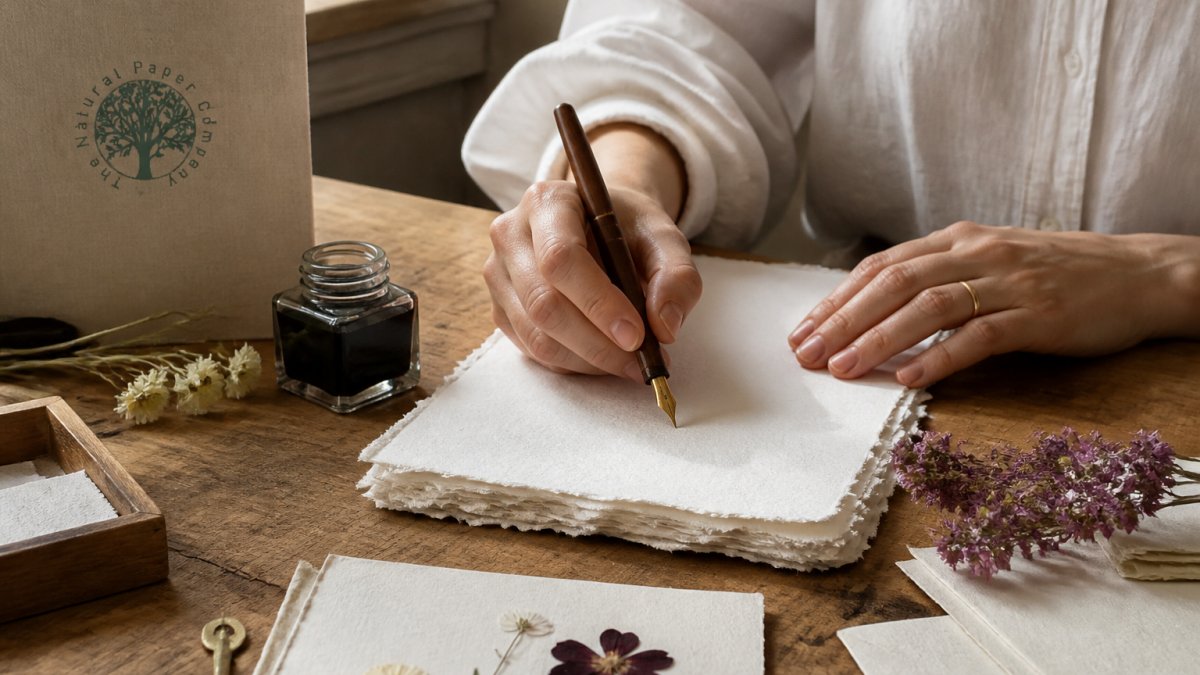
Fountain pens, calligraphy nibs, and home printers all behave differently on textured paper. A well-made handmade sheet handles all three, with caveats. Test a sheet the way you will actually use it: bleed-through, feathering, drying time, opacity, and texture grip.
The Five Tests That Actually Matter
- Texture grip: write a line of pencil and a line of ink. A medium-rough texture grips ink and pencil without skipping; a very rough sheet can catch a fine nib and cause railroading in calligraphy.
Fountain Pens and Calligraphy
Fountain pen users rightly worry about bleed-through. Match nib width and ink wetness to paper weight: a fine nib and dry ink behave on 150 gsm, while a broad, wet nib wants 300 gsm card or a tighter fibre structure. Calligraphy nibs are the harshest test, a sharp pointed nib can catch on a very rough deckled surface, so test before a place-card run.
Printers: The Trickier Case
Textured paper does not feed through every home printer cleanly, and heavy 300 gsm card will jam a standard inkjet. Use a printing service that handles textured stock, or test a single sheet first. Set your printer to its heaviest stock setting, feed sheets one at a time, and leave prints to dry fully before stacking.
What the Tests Tell You
If a sheet passes bleed-through and feathering with your pen and ink, it serves for correspondence and journaling. If it also feeds cleanly and holds colour, it serves for printed invitations. If it fails any test, move up a weight or choose a tighter-finished sheet rather than abandoning handmade paper. You gain texture and character, and accept that you must test rather than assume.
Handmade Paper Wedding Invitations: Where the Value Shows
5 X 7 Handmade Card Pocket Invitation Premium White gives you a ready-made starting point if you want the handmade look without assembling from loose sheets. The Premium White Handmade Paper is available as 300 gsm card.
Premium White Handmade Paper (vegan) →
Sustainable Wedding Invitations and Sourcing Claims
The Premium White Handmade Paper is made from recycled cotton rag and is acid-free. The Lokta paper is made from the inner bark of wild-growing daphne shrubs; its listing says harvesting supports regrowth and causes no lasting harm to forests.
The government guidance on environmental claims is clear that vague green language without evidence is a problem, so ask suppliers specific questions: what fibre, where from, and what happens to the waste. A supplier who can answer plainly is usually the one worth buying from.
DIY Wedding Invitation Printing on Textured Paper
For more detailed guidance, our DIY wedding invitations guide walks through the full process with tips for professional-looking results.
We also offer a personalised printing service.
Who Gets the Most From Artisanal Stationery
The British Library's guidance on caring for paper collections is a useful reminder that acid-free paper is the difference between a guest book that lasts and one that yellows in a decade.
A single sheet of Nepalese Handmade Lokta Paper is listed at £0.40.
If you are ready to buy, our guide to the best shops for premium handmade stationery covers where to source with confidence.
Buying artisanal stationery is a decision about what your paper needs to do.
The Natural Paper Company offers Premium White Handmade Paper in 150 gsm paper and 300 gsm card, and a personalised printing service. Its range includes recycled cotton rag paper and Lokta paper made from the inner bark of daphne shrubs.
Frequently Asked Questions
Is handmade paper worth the extra cost?
A sheet of Premium White Handmade Paper is £2.25, and a sheet of Nepalese Handmade Lokta Paper is £0.40. The right choice depends on your project.
Does handmade paper work with home printers?
The verified product information does not specify compatibility with home printers. The Natural Paper Company offers a personalised printing service.
How does artisanal stationery compare with mass-produced stationery?
The Premium White Handmade Paper has a medium-rough surface and a deckled edge. The Lokta paper has a textured finish and soft natural tones.
Is artisanal stationery a good choice for wedding invitations?
The Premium White Handmade Paper is available as 150 gsm paper and 300 gsm card. Its listing describes the paper as suitable for wedding invitations, stationery, watercolour painting and calligraphy. A sheet is £2.25.
