

How to Choose Premium Textured Envelopes for Invitations
Quick Summary
Choose textured envelopes sized to your finished card, with a few millimetres of clearance and extra room for inserts. A folded A6 card fits a C6 envelope, and cotton rag or Lokta finishes suit formal or rustic invitations. Order a sample pack first to check fit, colour and ink.
- Measure your card as it will be posted, folded and with any inserts inside.
- Allow at least 3-5mm clearance on each dimension for a single card.
- Cotton rag envelopes are about 150 gsm, acid free, and suit calligraphy.
- Test your pen on the actual envelope stock, since texture affects how ink sits.
- Order a sample pack to check colour, because screens and lighting can mislead.
Table of Contents
- Why Textured Envelopes Make Invitations Feel Premium
- Envelope Sizes for Invitations and How to Match Them to Your Card
- Paper Weight, Finish and Texture: Comparing Cotton Rag, Lokta and Felt-Style Options
- Coloured Envelopes for Invitations: Pairing Shades With Your Stationery
- Eco-Friendly Envelopes for Invitations and Responsible Sourcing
- How to Address Wedding Invitations on Textured Envelopes
- Pricing, Bulk Orders and Ordering Samples Before You Commit
- Ordering Your Invitation Envelopes With The Natural Paper Company
- Frequently Asked Questions
Textured envelopes do more than hold an invitation. They set the tone before a guest reads a single word. For couples planning an eco-conscious wedding, the envelope is often the first physical thing a guest touches, so it deserves the same care as the card inside.
At The Natural Paper Company, we offer envelopes made from recycled cotton rag and Lokta paper, and customers often ask the same questions. This guide walks through how to choose premium textured envelopes for invitations, from size and paper weight to colour, ethics and ordering.
Why Textured Envelopes Make Invitations Feel Premium
A textured envelope signals care. Deckled edges, a visible fibre pattern and a slightly soft surface all tell the recipient that the invitation was chosen with thought. Smooth, machine-made envelopes read as functional. Textured ones read as a keepsake.
The texture also does practical work. Rough surfaces hide handling marks, and the fibres give a pen a pleasant, slightly resistant feel when addressing. Our cotton rag envelopes, for example, have a medium-rough surface and are described as a perfect envelope for calligraphy.
Envelope Sizes for Invitations and How to Match Them to Your Card
Size is the first decision, and it has to fit the card, not the other way round. Measure your finished card before you order anything, and measure the card as it will be posted, folded, with any inserts inside, rather than as a flat sheet.
Common sizes for invitations include:
- C6 (about 16.6cm x 12cm), a good match for A6 cards
- 5 x 7 inches (about 19cm x 14cm), a popular wedding format
- C5 (about 22.75cm x 16.5cm), suited to A5 cards or a folded A4 sheet
- DL (about 11.5cm x 21.5cm), often used for slim, portrait-style invitations
Matching card dimensions to envelope size
A folded A6 card (when folded, about 10.5cm x 14.8cm) sits comfortably in a C6 envelope. A folded A5 card (about 14.8cm x 21cm) needs a C5 envelope. A 5 x 7 inch card (about 12.7cm x 17.8cm) fits a 5 x 7 inch envelope, but check the stated internal dimensions, because some envelopes are described by their outer size. A DL envelope suits a slim card or a folded A4 sheet folded into three.
Allowance for thickness and inserts
A single card needs only a few millimetres of clearance so it slides in without bending. Once you add an RSVP card, a details card, a map or a tissue sheet, the stack becomes thicker and the envelope needs more room. As a working rule, allow at least 3-5mm clearance on each dimension for a single card, and more where inserts are included. If the stack feels tight, move up a size rather than forcing it, because a bent corner on a textured envelope is difficult to disguise.
Flat sheets and inserts
Flat sheets do not fold, so match the envelope to the sheet's full dimensions plus clearance. Inserts should be slightly smaller than the main card so they do not press against the envelope edges. Where an insert is thicker than the main card, place it behind the card rather than in front, so the address panel stays flat.
A worked example
A folded A6 card with one RSVP insert: measure the folded card (about 10.5cm x 14.8cm) and the insert, then choose a C6 envelope and check that the combined stack slides in with a few millimetres to spare.
Our envelopes list matching handmade paper and card sizes, so the listings show which sets are designed to fit together. Always check the stated dimensions, since deckled edges add a little to the visible size.
Watch out: deckled edges and handmade variation mean two envelopes from the same range can differ slightly, so test the fit with the actual envelope you plan to use, not a similar one.
Paper Weight, Finish and Texture: Comparing Cotton Rag, Lokta and Felt-Style Options
Paper weight, measured in gsm, affects how an envelope feels and how well it protects its contents. Heavier paper feels more substantial but can be stiffer to fold.
| Texture | Typical weight | Feel | Best for | Watch out for |
|---|---|---|---|---|
| Cotton rag | About 150 gsm | Soft, medium-rough, acid free | Calligraphy, formal invitations | Slightly thicker, so check the card still slides in |
| Lokta | Varies by style | Fibrous, natural tones | Rustic or artisan stationery | Visible fibres can catch fine nibs |
| Felt-style | Varies by style | Soft, cushioned | Relaxed or textural themes | Less suited to very fine writing |
Cotton rag is made from 100% long-fibred cotton rag and is acid free so it will not yellow with age. The 150 gsm weight is the listed weight for our premium envelopes.
Lokta has a distinctive fibrous look and warm, natural colour. It suits rustic weddings and handmade gift wrapping. Test it with your pen first, because the texture can catch a fine nib.
Pros and cons at a glance:
- Cotton rag: pro, reliable writing surface; con, slightly heavier to post
- Lokta: pro, distinctive natural character; con, texture can interfere with fine pens
- Felt-style: pro, tactile and cushioned; con, less suited to very fine detail
Basic test for any sample: Write a line with your intended pen, let it dry for a minute, then rub it gently.
You can browse our Vanilla Handmade Cotton Rag Envelopes to compare the cotton rag finish in person, and our Handmade Bumble Bee Lokta Paper Notecard Set shows how Lokta looks alongside a card.
Coloured Envelopes for Invitations: Pairing Shades With Your Stationery
Colour is where many couples get stuck, because a shade that looks right on screen can look different in daylight. The most reliable approach is to start with your card and build outward, then test the pairing against a physical sample before committing to a full run.
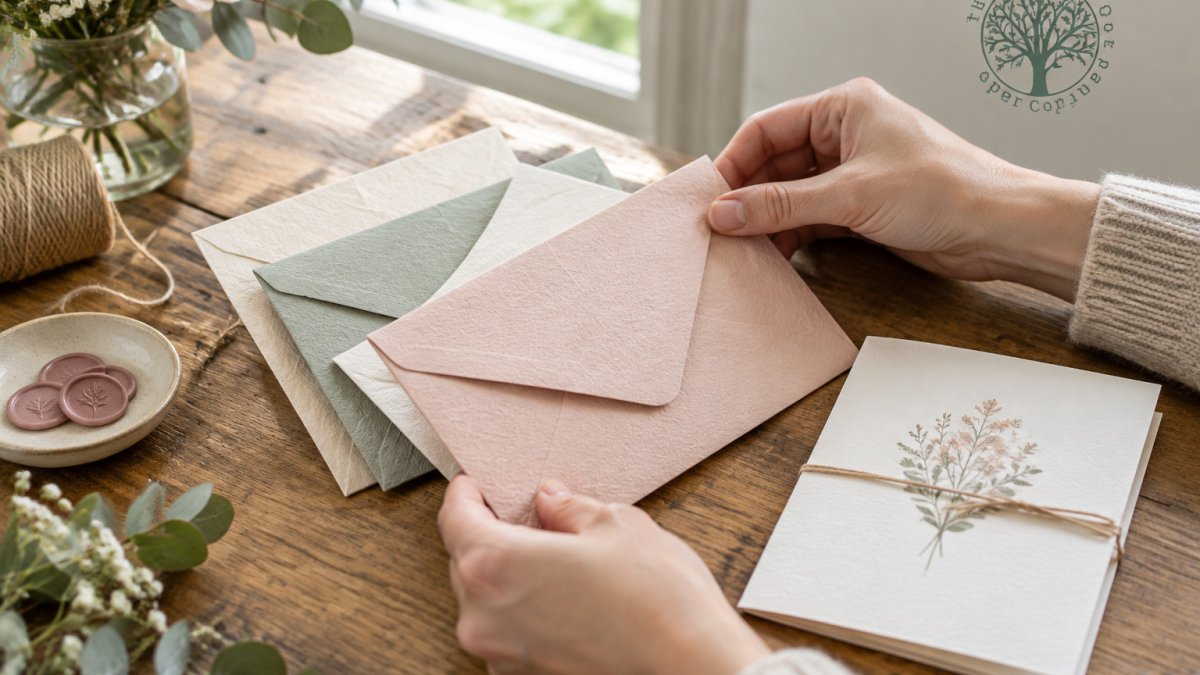
Four pairing strategies
Complementary. Pick two colours opposite each other on the colour wheel, for example a soft sage green envelope with a blush pink card, or a mustard envelope with a dusty lilac card. This gives a lively, contemporary look. Keep one shade muted so the pair does not compete.
Analogous. Choose shades next to each other on the wheel, cream card with a natural or oatmeal envelope, or ivory card with a pale sand envelope. This is the safest route for formal weddings and reads as quietly expensive.
Neutral. Let the card carry the colour and keep the envelope in white, cream, natural or grey. A white envelope keeps a minimalist theme crisp; a natural envelope softens a bright card without introducing a second hue.
Contrast. Pair a dark envelope with a light card, or the reverse, a deep charcoal or navy envelope with an ivory card, or a white envelope with a deep-toned card. Contrast makes the address panel easier to read and gives the suite a graphic edge.
Common palettes and what to pair with them
- Blush and cream: a blush envelope with a cream card, or a natural envelope with a blush card for a softer inversion.
- Sage and ivory: sage envelope with ivory card for a garden theme; ivory envelope with sage card for a more restrained look.
- Natural and white: natural envelope with a white card for rustic themes; white envelope with a natural card for a cleaner finish.
- Deep tones: charcoal or navy envelopes suit ivory or white cards and metallic inks, but check ink contrast before ordering.
Matching ink and addressing colour
A coloured envelope changes which ink colours remain legible. Dark envelopes generally need light ink, white, cream or metallic, while pale envelopes take dark ink comfortably. Test your intended pen on the actual envelope stock, not on a similar-looking paper, because texture affects how ink sits. If you plan to print addresses rather than hand-write them, confirm with your printer that the envelope stock is suitable for their process before the run.
Checking colour before you buy
Order a sample pack before committing to a full run. Colour can shift under different lighting, and a physical sample is the only reliable check. Compare the sample against your card in daylight and under indoor lighting, and keep a note of the batch or shade name so a reorder matches. If you are unsure where to find a wider range, our guide to where to buy coloured envelopes in the UK lists the options.
Watch out: screens, studio lighting and batch variation can all make a shade look different from the delivered stock, so never approve a bulk order from a screen image alone.
Eco-Friendly Envelopes for Invitations and Responsible Sourcing
Sustainability should be checked, not assumed. Look for clear information on fibre source, whether the paper is recycled, and whether harsh chemicals are used in production. Our handmade envelopes are listed as made from recycled cotton rag, acid free and produced without harsh chemicals.
Ask any supplier for specifics rather than accepting the word "eco" on its own.
How to Address Wedding Invitations on Textured Envelopes
Textured envelopes need a little more care when addressing. Use a pen with smooth, fine ink and test it on a scrap first, because heavy pressure can tear or flatten fibres.
Write the address in the centre of the envelope, leave comfortable margins, and use a steady hand. Calligraphy looks especially good on cotton rag. Allow extra time, because a mistake on a textured envelope is harder to correct cleanly.
Pricing, Bulk Orders and Ordering Samples Before You Commit
Prices for our envelopes start from £0.45 for natural white handmade envelopes, rising to £0.65 for the premium white vegan envelope, £1.40 for the blush handmade envelope and £1.85 for the natural handmade envelope. Prices are per envelope, so multiply by your guest count plus a spare margin of 10 to 15 per cent. Check current prices on each product page before ordering.
Consider ordering a sample first to check colour, texture and fit with your card. Keep a few spare envelopes too, since handmade stock can vary slightly from piece to piece.
Handmade envelope prices per envelope (GBP)
Ordering Your Invitation Envelopes With The Natural Paper Company
Start by measuring your card, then choose a texture and colour that suit your theme. Order a sample pack, test your pen, and confirm the fit. Once you are happy, place your full order and allow time for handmade production.
We are glad to help you pick the right combination for your wedding. Explore the full range at The Natural Paper Company and order your samples today.
Frequently Asked Questions
What is the best envelope for wedding invitations?
For most wedding invitations, a handmade envelope in 150 gsm cotton rag with a deckled edge gives a strong, premium feel and holds its shape well. The Premium White Handmade Paper Envelope, priced at £0.65, is made from recycled cotton rag, is acid free so it will not yellow with age, and has a medium-rough textured surface. Choose the size first, then the colour, so the envelope fits the card and the stationery set looks coordinated.
Which envelope size should I choose for my invitations?
Measure your finished invitation card first, then choose an envelope that fits it with a small margin. The Natural Paper Company lists C6 (about 16.6cm x 12cm), 5 x 7 (about 19cm x 14cm), DL (about 11.5cm x 21.5cm) and C5 (about 22.75cm x 16.5cm) envelopes with deckle edges. A 5 x 7 envelope suits a 5 x 7 card, while a C5 envelope is a good fit for an A5 card or a folded A4 sheet.
Can you write on handmade paper envelopes?
Yes. The envelopes have a medium-rough surface, and the listings describe them as a perfect envelope for calligraphy. Test your pen or ink on a spare envelope first, as textured surfaces can absorb ink differently from smooth paper.
How do I address and seal premium invitation envelopes?
Write addresses in the centre of the envelope in a steady hand, using a pen that suits textured paper. The envelopes have a diamond flap. For a finishing touch, the listings suggest sealing them with one of our wax stamps.
