

7 Steps to Source Bespoke Green Wedding Invitations
Last Updated: October 29, 2026
Quick Summary
To source bespoke green wedding invitations, choose 100% recycled cotton rag paper, check that finishes like foils and laminates are plastic free, and confirm the exact fibre content with the seller before ordering. Order matching envelopes and test-print on the real stock before committing to the full run.
- Choose 100% recycled cotton rag paper, which is acid free and will not yellow over time.
- Avoid plastic-based foils, laminates and glitter, since they undo the green credentials of the paper.
- Measure the finished card and order a spare envelope to test the fit before printing.
- Order physical proofs on the exact stock, because green shifts noticeably on textured paper.
- Work backwards from the wedding, ordering samples at least eight weeks before posting.
Table of Contents
- What Makes a Wedding Invitation Genuinely Green
- Step 1: Choose Recycled Cotton Rag Paper
- Step 2: Match Envelopes Before You Print
- Step 3: Plan a Bespoke Design Process
- Step 4: Seal Your Invitations Sustainably
- Step 5: Budget and Timeline for Your Order
- Common Mistakes When Sourcing Green Invitations
- Booking Your Sample Pack and Starting Your Order
- Frequently Asked Questions
What Makes a Wedding Invitation Genuinely Green
Choosing eco-friendly stationery is about more than a leafy logo. A green wedding invitations set uses recycled or responsibly sourced paper, avoids harsh chemicals in production, and is designed to be kept, not binned.
The first thing to check is the fibre. Cotton rag paper is made from cotton fibres rather than timber pulp, and it can be acid free, so it will not yellow over time. Compare cotton rag with wood pulp to see when each suits your project. That durability matters, because an invitation that lasts is a more sustainable choice than one that ends up in the recycling bin after a week.
Next, look at the finishing. Many "eco" stationery products use plastic-based foils, laminates or glitter. These undo the green credentials of the paper underneath. A genuinely green invitation keeps its finishes simple and its materials honest.
Watch out: a card labelled "recycled" can still contain a large share of virgin fibre. Ask the seller for the exact fibre content before you order.
Step 1: Choose Recycled Cotton Rag Paper
Cotton rag paper is the foundation of a bespoke green invitation. It has a medium-rough textured surface and a deckled edge, and is suitable for calligraphy and watercolour. Our Dusky Green Handmade Paper, at £4.50, is made from 100% recycled cotton rag, is vegan and acid free, and is suitable for wedding stationery.
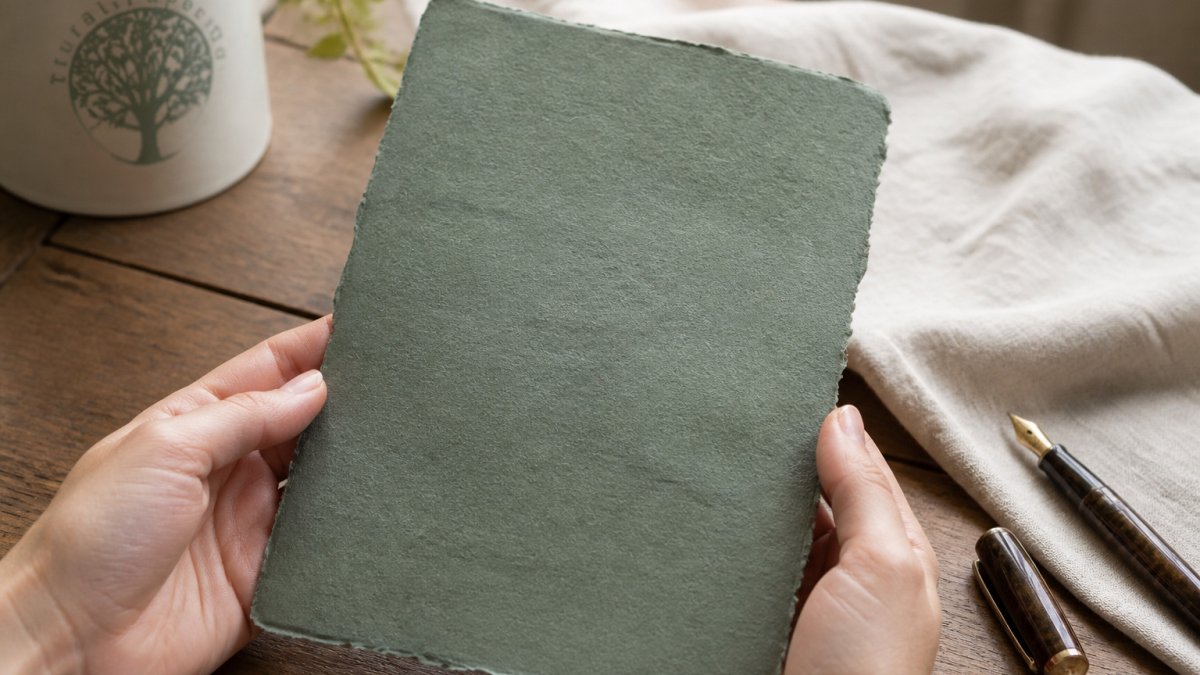
For a sustainable stock, start by deciding how much texture you want. A rougher deckled edge feels handmade and relaxed. A smoother sheet suits formal print. Both can be genuinely green if the fibre is recycled.
- Choose 100% recycled cotton rag where possible
- Check the gsm for the weight you need (our paper is 150 gsm)
- Confirm the sheet size before you design, so the layout fits
Checking Paper Weight and Surface Finish
Weight is measured in gsm (grams per square metre). Invitations usually sit between 150 and 300 gsm. Lighter paper feels delicate but can show print through.
Run your thumb across the surface before buying. A medium-rough finish takes ink and watercolour well, but test your printer or pen first, because textured paper can behave differently from smooth stock.
Our Dusky Green Handmade Card, at £2.50, is a heavier option that pairs with matching paper.
Forest Stewardship Council guidance on responsibly sourced paper
Step 2: Match Envelopes Before You Print
Envelopes are where many couples running green wedding invitations run into trouble. A beautiful invitation that does not fit its envelope has to be reprinted, which wastes both paper and money. Measure your finished card first, then choose envelopes that fit with a little room to spare. Securing the flap with a personalised wedding wax seal adds a final touch of elegance that ensures your stationery remains perfectly enclosed while reflecting your unique aesthetic.
Our Dusky Green Handmade Paper Envelope, at £1.85, is sized to fit our 5 x 7 handmade paper and card. Browse eco-friendly envelopes in matching colours to find the right fit.
A common mistake is ordering envelopes in a different colour from the card. See the full range of cotton rag card and envelope sets to order the matching set together. Even a small shade difference shows up in photographs. Order the matching set together where you can.
- Measure the finished card, including any folds
- Order one spare envelope to test the fit
- Choose the same paper family for a unified look
Step 3: Plan a Bespoke Design Process
A bespoke design process means working out the look, wording and layout before any paper is cut. The difference between a smooth commission and a stressful one is usually the brief, so treat the first consultation as a structured interview rather than a chat about colours.
The Bespoke Consultation Checklist
Bring these questions to your first meeting with a designer or stationer. A good supplier will answer them without hesitation; vague answers are a warning sign.
- Fibre and certification: Which exact stock are you proposing, and can you confirm the recycled content and any certification (for example FSC-certified or 100% recycled cotton rag)? Ask for the mill or merchant name.
- Inks and finishes: Are the inks water-based or soy-based? Are foils, laminates or glitter involved, and if so are they plastic-free and biodegradable?
- Proofing: How many proof rounds are included, and are they physical proofs on the actual stock or screen proofs only?
- Spoilage and reprints: What is your policy if handmade paper tears or marks during printing, and who bears the cost of a reprint?
- Lead time: What is the working-days lead time from signed proof to delivery, and does that include finishing and drying time for wax or foil?
- Minimum order: Is there a minimum quantity, and how does the per-unit price change at higher volumes?
- Packaging: How will the finished suite be packed, and is the packaging plastic-free and recyclable?
- Data and wording: Who checks names, spellings and table-plan details, and at what stage is the wording locked?
Colour, Typography and Layout
Start with your colour palette. Read practical tips for professional DIY invitations on design, printing and embellishments. Dusky green works well with cream, ivory and warm neutrals, and it pairs naturally with natural wax seals. Ask the designer to show the palette on the actual stock, not on a screen, because green shifts noticeably between a backlit display and textured paper.
Next, settle the typography. Simple serif fonts read well on textured paper. Keep text sizes large enough to read, especially for older guests, and ask for a printed proof at final size rather than judging from a PDF.
Finally, prepare print-ready files if you are supplying artwork. If you print at home, test your colours on a spare sheet. Greens often shift between screens and paper, so a test print saves disappointment later.
British Standards guidance on print colour consistency
Step 4: Seal Your Invitations Sustainably
A wax seal is a lovely finishing touch, and it can be a sustainable one. Our Sealing Wax Stick in Sage Green, at £1.50, is made with sustainable natural resins and beeswax, and it is plastic free, paraffin free and biodegradable. Each stick should make between 10 and 15 seals, depending on thickness.
Dusty Green Handmade Paper (vegan) →
To use it, melt the wax with a temperature-controlled glue gun or a melting spoon over a low flame. Press a stamp into the warm wax and let it set for a few seconds before moving the envelope.
Pair the seal with your envelope and keep the rest of the stationery free of plastic packaging where you can.
Step 5: Budget and Timeline for Your Order
Budgeting for green stationery means counting every component, not just the card. A typical bespoke set includes the invitation card, inserts, envelopes, seals and postage. Add a small margin for spoilage, since handmade paper can tear or mark during printing.
A Worked Cost Example
Take a suite for 80 households: one invitation card, one reply card, one envelope and one wax seal per household, plus 10 per cent spares.
- Invitation card at £2.50 each: 88 cards = £220.00
- Insert or reply card at £4.50 per sheet, cut to size: 88 inserts = £396.00
- Envelope at £1.85 each: 88 envelopes = £162.80
- Sealing wax at £1.50 per stick, roughly 10 to 15 seals per stick: 7 sticks = £10.50
- Materials subtotal: £789.30
Then add printing or calligraphy, which is usually quoted per unit and varies with the technique, plus postage. A large letter stamp costs more than a standard first-class stamp, so weigh a finished suite before you buy stamps in bulk. Build in a 10 per cent contingency on the materials subtotal, about £79, to cover spoilage and reprints.
Timeline: Work Backwards from the Wedding
Plan your timeline backwards from the wedding date. Invitations usually go out around six to eight weeks before the day, so order samples well before that point.
-
Samples and stock selection: at least 16 weeks before the wedding
-
Design brief and first proof: 14 weeks before
-
Signed proof and print run: 10 to 12 weeks before
-
Finishing (wax seals, assembly): 8 to 10 weeks before
-
Posting: 6 to 8 weeks before
-
Set a total budget and allocate it to paper, print, envelopes and seals
-
Build in a 10 per cent margin for spares
-
Order samples at least eight weeks before posting
-
Weigh a finished suite before buying postage in bulk
Common Mistakes When Sourcing Green Invitations
A frequent error is treating "eco" as a single label. Check the fibre, the finishes and the packaging separately. Another is ordering without testing. Always test your ink, pen or print on the exact paper before you commit.
Many couples also forget the reply cards and insert sheets. Buy these in the same paper family so the suite stays consistent. Finally, do not skimp on envelopes. A poorly fitting envelope spoils the whole impression.
Booking Your Sample Pack and Starting Your Order
Once you have chosen your stock, you can move on to design and printing with confidence.
Frequently Asked Questions
What materials make wedding invitations eco-friendly?
Eco-friendly wedding invitations are usually made from recycled or cotton rag paper, which uses cotton waste fibres rather than virgin wood pulp. Look for acid-free, vegan paper with no harsh chemicals in production, such as the 150 gsm Dusky Green Handmade Paper at £4.50 per sheet. Pair it with envelopes and sealing wax made from sustainable materials, such as the Sage Green Sealing Wax Stick at £1.50, which is plastic-free, paraffin-free and biodegradable.
Are green wedding invitations more expensive than standard options?
Handmade sustainable stationery usually costs more per sheet than mass-produced card, because each sheet is made by hand with traditional methods. At The Natural Paper Company, a single sheet of Dusty Green Handmade Paper costs £4.50, a matching card £2.50 and a matching envelope £1.85. Buying a small sample set first lets you judge the quality before committing to a full guest list.
How do I find bespoke stationery designers in the UK?
Start by looking for designers who state their paper sourcing and printing methods clearly, and ask whether they offer a design consultation. A good bespoke service will talk through your colour palette, typography and quantities before printing begins.
What is the best paper weight for luxury wedding invitations?
Heavier papers feel more substantial and hold their shape better when posted. The Dusky Green Handmade Card is 300 gsm, and the Dusky Green Handmade Paper is 150 gsm, making it suitable for lighter inserts and layered invitations. Test how the paper handles your chosen ink or pen before ordering, especially if you plan to write guest names by hand.
